AI search optimization means shaping your company’s content, site structure and brand signals into a form that AI-powered search experiences can understand. A good result is not only a higher Google ranking. It means ChatGPT, Perplexity, Gemini or Google AI Overviews may mention your business or use your page as a source.
For a small or mid-sized business, this affects the beginning of the sales process. If a buyer asks an AI tool “who does SEO consulting for small businesses” or “how much does SEO cost”, the system builds an answer from sources it considers reliable. If your site does not explain what you do, who you help and why you are credible, you are unlikely to appear in that answer.
Start with the SEO foundation. AI search optimization extends SEO into environments where the user receives a compiled answer. The work still begins with crawlability, clear content, internal links and trust.
This starting model is not a market statistic. For most SMBs, the first sensible step is to improve 3 to 5 pages closest to revenue and monitor the effect monthly for several months.
In This Guide
- What is AI search optimization?
- How does it differ from SEO, AEO and GEO?
- Why should SMBs care?
- Who is AI search optimization for?
- What does AI search optimization include?
- The process
- 10 practical tips
- How to measure AI visibility
- Common mistakes
- 30-day plan
- Cost and prioritization
- Summary
What is AI search optimization?
AI search optimization improves a company’s web content, technical structure and brand trust signals so AI-powered search services can understand, evaluate and use the business in their answers. It extends traditional SEO into AI search and answer engines.
The foundation is the same as good small business SEO: the page must be discoverable, technically readable, useful and trustworthy. GEO, AEO and LLM optimization add one more question to SEO: can an AI system use this page as a clear source?
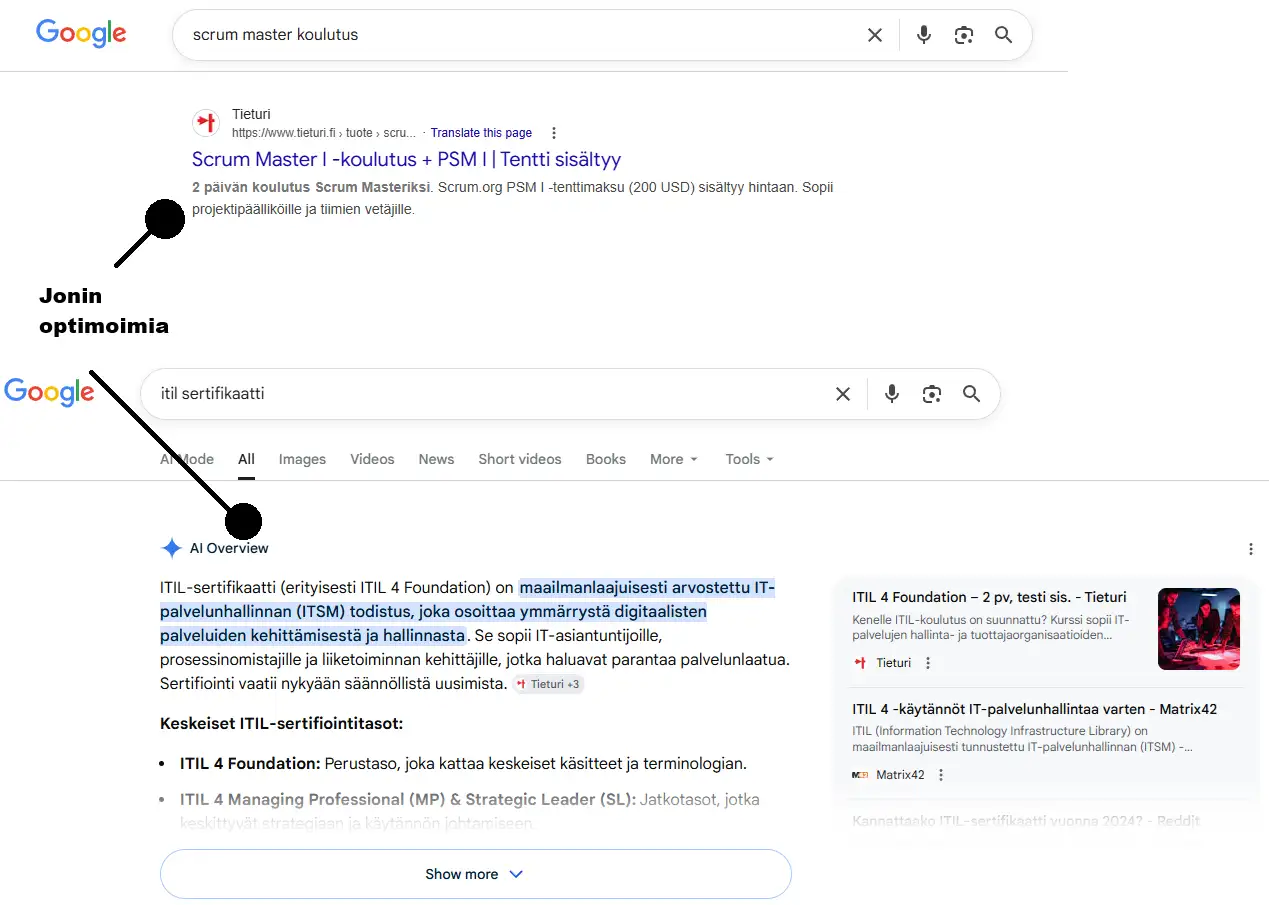
In traditional search, the user sees a list of links and chooses one. In AI search, the user gets a compiled answer. That answer may include source links, brand mentions or recommendations, but the user may never click a standard search result. Ranking third may not be enough if the AI answer cites the fifth result and leaves you out.
AI search optimization makes your content useful as a source. A good source answers directly, shows experience, includes facts and connects logically to the wider topic. Show the limits: who the service is for, what it costs, when it should not be bought and what outcome the buyer can expect.
How does AI search optimization differ from SEO, AEO and GEO?
AI search optimization is the umbrella term. SEO makes the site discoverable, AEO makes content answer-ready, GEO builds citability in generative systems and LLM optimization helps language models understand the brand in the right context.
| Term | What it optimizes | What you measure |
|---|---|---|
| SEO | Rankings and organic traffic in Google | Rankings, clicks and conversions |
| AEO | Direct answers and question-based searches | Featured snippets, People Also Ask and answer-ready blocks |
| GEO | Citability in generative search experiences | AI mentions, source citations and brand appearances |
| LLM optimization | How language models understand the business and entities | Brand queries, entity connections and external mentions |
| AI search optimization | All of the above tied to a business goal | Leads, sales, AI referrals and reliable visibility |
If you use these terms as synonyms, prioritization breaks. A GEO article can explain how generative engine optimization works. In day-to-day business, you need decisions: which page should be fixed, which questions should be answered, what should be measured and how much time is worth spending.
How is GEO different from traditional SEO?
GEO, or generative engine optimization, aims to earn a place among sources used in AI answers. Traditional SEO usually measures rankings and traffic. GEO also tracks brand mentions, source citations in AI answers and visibility without a click.
The same page can serve SEO and GEO if it is technically readable, answer-first and specific enough. GEO optimization belongs to the same visibility work as SEO.
Does AI search optimization work with traditional SEO?
In most companies, the best result comes from doing traditional SEO and AI search optimization together. If a page does not rank, loads poorly or answers the question vaguely, it has a weak chance of appearing in AI answers.
Set the expectation correctly. As a service, AI search optimization usually means extending existing SEO work, not opening a completely separate workstream. When you improve service pages, articles, comparisons and pricing content, the same work supports both Google visibility and AI search.
For a deeper technical foundation, read the technical SEO guide. It covers crawlability, schema, internal links and crawler access, which all matter in AI search.
Why should SMBs care about AI search optimization?
An SMB loses the early decision stage if it does not appear in AI answers. Some buyers now ask AI tools about options, prices, risks and recommendations before opening a regular search result.
In B2B services, the buyer often shortlists providers before contacting anyone. They do not only ask “SEO consultant”. They ask questions such as:
- “What is a reasonable SEO budget for a small B2B company?”
- “Should we invest in technical SEO or content first?”
- “Who can help with AI search visibility?”
- “What does AEO optimization include in practice?”
- “How do I know whether an SEO consultant is credible?”
The buyer asks these before making contact. If AI systems build answers from competitor pages, industry media and international sources, your business stays invisible at the point where trust starts to form.
Does AI search optimization bring high-quality traffic?
AI search optimization can bring higher-quality traffic when it appears for the right decision questions. A brand mention in any AI answer does not automatically help sales. Value appears when the buyer asks about price, alternatives, fit or risk and then lands on a page that helps them take the next step.
Target pages with a commercial role first: service pages, pricing articles, comparisons, process descriptions and guides that reduce buying uncertainty. An AI referral does little if the visitor lands on a generic blog post with no clear next step. Good AI search optimization connects source-worthy content with a conversion page that makes contact easy.
Who is AI search optimization for?
AI search optimization fits companies whose buyers seek advice before contacting a provider. It works in expert services, B2B services and situations where the customer compares options, price, risk and fit before deciding.
Repeated sales questions reveal a good starting point. Buyers ask about price, process, fit and results. If those questions also appear in search behavior, AI search optimization can create visibility close to a purchase decision.
Do not start with AI search optimization if the company does not have clear service pages, if basic SEO is broken or if the topic has no search demand. Start with SEO fundamentals. A separate AI search consulting project makes sense only when the site already has something an AI system can use as a source.
Is AI search optimization only for large companies?
A small company can benefit because it can answer buyer questions more precisely than a large generic brand. A large brand benefits from recognition. An SMB can compete with clarity: what the service costs, who it fits, how the work proceeds and when the buyer should not buy it.
Do not start with dozens of new articles. Fix the 3 to 5 pages closest to a lead or sale. When those pages answer buyer questions better than competitor pages, AI systems have a better reason to use them as sources.
What does AI search optimization include?
AI search optimization has six parts: technical readability, answer-first content, trust signals, entity structure, internal linking and measurement. One part is not enough because AI systems evaluate the source as a whole.
Content factors:
1. Answer-first content
Answer-first means the section answers the question in the first paragraph. Context, nuance and examples come after that. The reader gets the answer quickly, and an AI system can extract the paragraph as a source.
Weak structure:
In recent years marketing has changed a lot, and companies need to think about new ways to appear online…
Better structure:
AI search optimization usually costs EUR 800 to EUR 2,000 as a one-off audit, or starts from around EUR 990 per month as part of ongoing SEO consulting.
The second version answers the question and gives the buyer a number they can use in a decision.
2. Trust signals
In AI search optimization, trust does not come from adjectives. “High-quality”, “expert” and “comprehensive” prove nothing. Trust comes from concrete signs:
- author name and expertise
- updated content
- first-hand observations and audit examples
- prices or at least price ranges
- clear process
- sources when referring to research or standards
- internal links to deeper articles
- external brand mentions and links
To appear in AI answers, the content needs to show the creator, experience and decision boundaries. A generic article may be grammatically fine, but it gives the model little reason to trust it.
3. Entity structure
An entity is a recognizable thing: a company, person, service, industry, place or topic. In AI search optimization, the model must connect these correctly.
For an expert website, make these points clear:
- who the expert or company is
- what services they offer
- which market they serve
- who the service is for
- which topics belong together
- what results or methods prove the expertise
One schema block does not build an entity by itself. Consistent language, internal links, service pages, articles, case studies and external mentions help the model understand what the company is known for.
4. Internal linking and topical authority
AI search optimization needs a topic cluster. One article about AI search optimization is not enough if the rest of the site does not support the claim.
For an expert site, the link structure can work like this:
- Small Business SEO 2026 explains the SEO foundation
- Technical SEO covers crawlability and structure
- WordPress SEO handles CMS-specific implementation
- Ecommerce SEO shows how AI search connects to online store visibility
- SEO consulting connects the topic to the service
Google and AI systems can see from links that the topic is not sitting on one isolated article.
Technical factors:
5. Technical readability
An AI system cannot use a page it cannot find or understand. Check the technical base first:
- important pages are not set to
noindex - robots.txt does not block useful crawlers without a reason
- service pages are reachable through internal HTML links
- pages have a clear H1-H3 structure
- JavaScript does not hide core content from crawlers
- the page works on mobile without hiding content or CTAs
- schema supports the page type: Article, Service, BreadcrumbList and FAQPage where appropriate
Technical SEO uses the same foundation. In AI search optimization, the technical setup also affects whether the page can become a source.
Structured data is not a magic button, but it helps machines interpret the page role. For an article, Article or BlogPosting markup, breadcrumbs and clear question-answer content support readability. For a service page, Service and Organization data do the same job. Schema must match visible content and should not promise things the page does not say.
How do llms.txt and llms-full.txt relate to AI search optimization?
llms.txt and llms-full.txt can support site-level readability for AI systems. They explain what the site is about and which pages can serve as sources for different topics. They are not a ranking factor or shortcut to AI visibility. Treat them as low-cost documentation that complements good site architecture.
6. Measurement
Without measurement, AI search optimization becomes an opinion. AI visibility does not yet appear in one clean report like Google Search Console.
You need a combination:
- GSC: organic impressions, clicks and question-based queries
- GA4: referral traffic from ChatGPT, Perplexity, Gemini and Copilot
- CRM: whether a lead mentioned an AI tool or guide
- manual test queries: whether the brand appears in relevant AI answers
- content change log: what changed and when the effect appeared
The AI search optimization process
AI search optimization works best as a seven-step process: current-state audit, question selection, technical fixes, content structure improvement, trust signal strengthening, internal linking and measurement. If you jump straight into content production, you can publish a lot of text that does not support the business.
How do you start GEO optimization?
A fast start looks like this:
- choose 3 to 5 pages closest to revenue
- check whether they answer price, fit and process directly
- fix crawlability, internal links and heading structure
- add answer-first paragraphs to the most important sections
- monitor GSC, GA4 and manual AI searches monthly
That list is enough for the first version of GEO optimization. After that, deepen the content, trust signals and external brand mentions.
Step 1: Audit current visibility
Start with three questions:
- Does the site already appear in Google for important service and problem searches?
- Does the site contain content an AI system could use as an answer?
- Does the site itself make clear what it wants to be known for?
Use Google Search Console, GA4, Screaming Frog, SERP analysis and manual test queries in ChatGPT, Perplexity and Gemini. Manual queries do not give perfect data, but they quickly reveal whether the brand connects to the topic.
Step 2: Choose commercially meaningful questions
Not all questions are equal. “What does AI mean” is too broad. “How much does AI search optimization cost for an SMB” is closer to a decision.
Choose a question that meets these conditions:
- the searcher could be a potential customer
- the answer requires expert judgment
- the answer has a natural next step
Keyword research helps choose topics, but volume does not decide everything. In AI search optimization, a small question close to buying can be more valuable than a broad term or long-tail query that never leads to a decision.
Step 3: Fix the technical foundation
If site structure is broken, content work leaks value. Check at least these:
- the sitemap includes important pages
- canonicals point to the right URLs
- pages do not have broken internal links
- mobile usability and loading speed are good enough
- Article and BreadcrumbList schema work
- service pages connect clearly to the company and the service
The technical check may feel dull, but skipping it costs more later. AI search optimization often exposes an older problem: the site does not explain things clearly enough to machines or people.
Step 4: Move important pages into an answer-first model
Choose the 5 to 10 most important pages first, not the whole site. Usually they are:
- main service pages
- highest-value blog articles
- pricing articles
- comparisons
- audit or case study pages
Add a clear definition, decision questions, process details and links to deeper articles. If the page has a commercial role, do not hide the CTA until the end.
SEO and AI search
Want to know whether your business appears in AI search?
I can do a free initial review of your site's basic visibility, AI search situation and the most sensible next fixes.
Step 5: Add your own observations and examples
AI can produce a general explanation of almost any topic. Add things a model cannot know without experience.
Add these to pages:
- observations from customer audits
- before-after examples
- typical budget levels
- situations where an action is not worth doing
- tools used
- metrics you monitor
Experience protects the content from becoming generic. If the text could appear on any agency website, it is too vague.
The same problem repeats in content audits: a company has articles, but the most important commercial answer is missing. The service page says what is done. The article explains the topic in general. Neither answers “what does this cost”, “who is this for” and “what happens in the first month”. The first fix is to rewrite the 3 to 5 most important pages around those questions.
Step 6: Strengthen the brand outside your own site
LLM optimization does not stop at your website. AI models also build their view from external sources: LinkedIn profiles, directories, customer mentions, podcasts, articles and links.
Realistic first steps for an SMB:
- keep the LinkedIn profile description consistent with the website
- publish expert posts about the same topics
- earn relevant directory mentions
- build links from topic-related sources
- publish case studies that show the work
Traditional links still help, and unlinked brand mentions can strengthen the entity.
Step 7: Update and measure monthly
AI search optimization is not a one-off publication. AI search experiences change, SERPs change and competitors publish new content. Monthly monitoring is enough for most SMBs.
Track:
- which pages gain more impressions
- whether AI referral traffic appears
- which questions produce mentions
- which pages AI systems ignore even when they should cite them
- what competitors do better
Business impact decides the value: does the visibility bring contacts, quote requests or sales conversations?
10 practical AI search optimization tips
This checklist covers most AI search optimization work:
- make sure important pages can be indexed
- start important sections with a direct answer
- answer price, fit and risk without dodging
- show author, date and first-hand perspective
- use consistent language for services and target customers
- link articles to service pages and service pages back to articles
- build content from real buyer questions alongside search volume
- update old high-value pages before ordering new articles
- track AI referrals, impressions and contacts as one system
- do AI search optimization with SEO, not as a separate side project
The same principles apply to AI optimization and LLM optimization. The term matters less than whether visibility appears for the right commercial questions.
How to measure AI search visibility
Measure AI search visibility by combining search data, analytics, AI referrals and qualitative test queries. No single tool gives a full picture, so you need several sources.
| Metric | What it tells you | Limitation |
|---|---|---|
| GSC impressions | Whether related search visibility grows in Google | Does not reliably separate AI Overview visibility |
| GA4 referrals | Whether traffic comes from ChatGPT, Perplexity or other AI services | Many AI answers produce no click |
| Manual test queries | Whether the brand appears in the right decision questions | Results vary by user and session |
| Conversions | Whether visibility creates leads or sales | Requires solid tracking and CRM notes |
| Brand mentions | Whether the company becomes a recognizable entity | Requires monitoring across several sources |
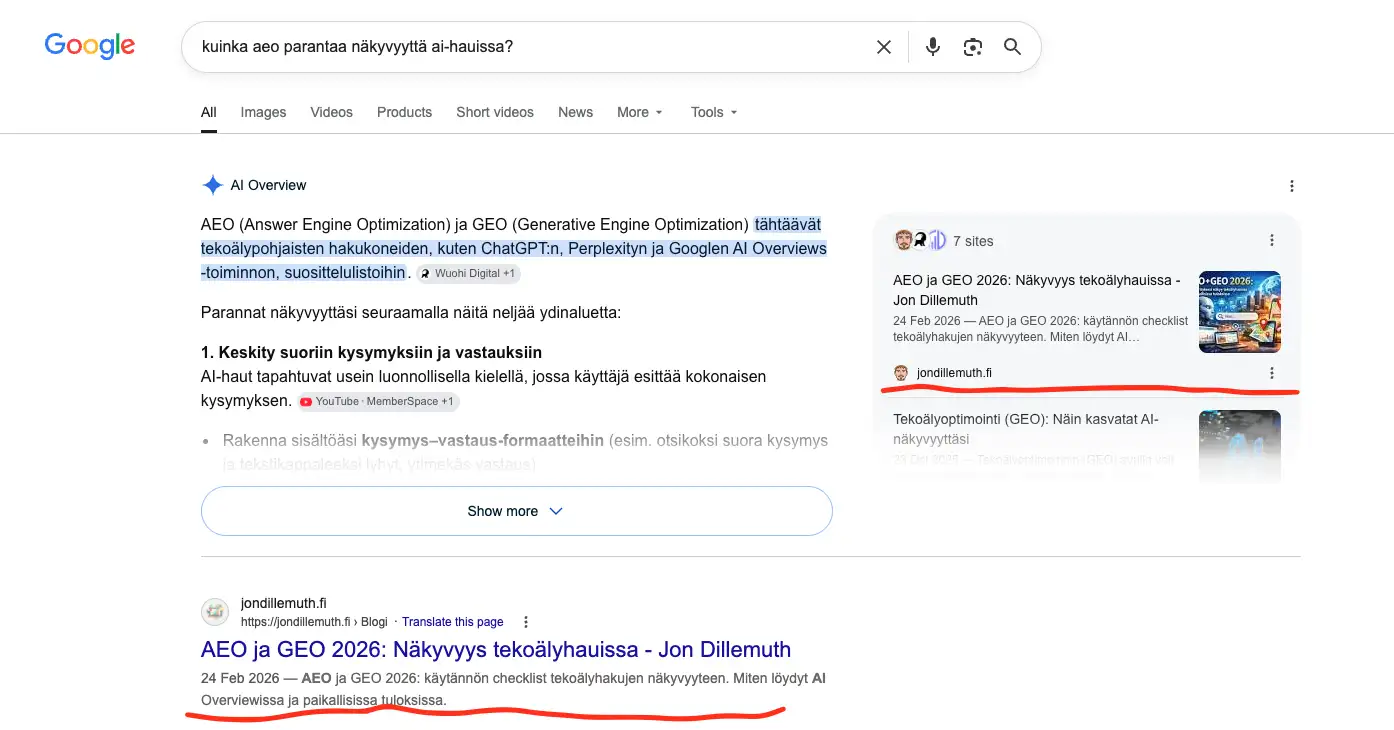
Accept that measurement is imperfect. The effect of AI search may appear indirectly: more brand searches, better contacts, longer sessions or a customer saying “I read your guide on this”. A useful report combines numbers and observations.
Common AI search optimization mistakes
The most common mistake is treating AI search optimization as a new hack. Strong AI visibility requires the same basics as strong SEO: clear content, technical reliability, trust and a connected topic cluster. AI does not reward unclear content just because the text says “AI”.
1. Terms pasted on top of old content
A few mentions of ChatGPT and Google AI Overviews do not turn an old SEO article into AI search optimization. The content structure must change: direct answers, questions, comparisons, process and measurement.
2. A topic that is too broad
“AI in marketing” is huge. “How a B2B service business appears in AI search” moves closer to the buyer’s situation. A precise question makes it easier to write the best answer.
3. No sources or experience
AI can summarize generic information by itself. Add your own experience: what you see in audits, how you prioritize, what customers ask and when you would not recommend an action.
4. No measurement
If you do not know which pages gained impressions, which AI referrals appeared and whether contacts increased, you do not know whether AI search optimization worked. Visibility without business impact is a vanity metric.
5. Skipping basic SEO
AI search emphasizes crawlability, content quality and authority. If the site is not a good source in Google, it has a weak starting point in AI answers too.
Is AI search optimization based on AI-generated content?
No. AI can speed up ideation, drafting or structuring, but AI-generated text does not create visibility by itself. Useful content, clear structure, technical readability and trust signals create visibility.
Publishing AI content is not AI search optimization. If the content is thin, generic or lacks a point of view, AI systems will not value it because of how it was produced.
30-day AI search optimization plan
The goal for the first month is to get the most important pages into a condition where they can work as sources. A good 30-day plan starts with an audit, continues with the improvement of 3 to 5 pages and ends with a monthly measurement model.
Days 1-5: current-state review
Collect facts during the first week. List pages that should create leads: main service pages, pricing articles, comparisons and guides. Check four things on each page:
- the page’s primary search intent
- the commercial question the page answers
- which internal links point to the page and where it links out
- whether the page has a clear answer, price, process or next step
Run 10 to 20 manual test queries in ChatGPT, Perplexity and Gemini. Ask things a real buyer would ask, such as “who does SEO consulting for small businesses”, “how much does SEO consulting cost” or “how can a company appear in AI search”. Record whether the answer mentions your company, competitors or generic sources.
Days 6-12: technical and structural fixes
Do not write new content in the second week yet. Fix blockers first. Check indexability, canonicals, internal links, heading hierarchy and page load. If an important service page is found only through a dropdown menu or an article does not link to the service page, AI search optimization starts from a weak position.
Give each priority page one clear H1, a logical H2 structure and 5 to 8 questions that answer decision pain points. FAQ is not decoration. Its job is to answer questions sales actually hears.
Days 13-20: content rewrites
In the third week, rewrite the most important pages into an answer-first model. Start from the service page or article closest to revenue. If you sell SEO consulting, the service page and pricing article matter more than a generic “what is SEO” post.
Add these to each page:
- a direct definition in the first paragraph
- decision questions as subheadings
- a concrete price range or pricing logic
- step-by-step process
- who the service fits and who it does not fit
- a link to the service page or contact page
Clarity helps the reader too. If the reader has to guess what the service costs or what happens next, AI receives an unclear signal as well.
Days 21-30: measurement and link strengthening
Build monitoring during the last week. Add an AI referral check in GA4, track priority-page impressions in GSC and create a monthly test query list. Keep the test queries the same, or comparison breaks.
Strengthen internal links at the same time. Link AI search optimization content to SEO consulting, the broader small business SEO guide, the technical SEO guide and relevant trust signals. Links show users and machines that the topic belongs to a wider expertise area.
What should you not do first?
Do not start by ordering a broad “AI content package” with dozens of new articles while current pages remain weak. It may look efficient, but it often increases messy content volume. If the most important service page does not answer price, process and fit, a new article will not solve the trust problem.
Do not start from tools. AI visibility monitoring tools already exist, but a poor page does not become better in a report. Build a page worth measuring first.
Do not chase every AI channel separately. ChatGPT, Perplexity, Gemini and Google AI Overviews work differently, but they reward the same basics: clear content, credible sources, recognizable brands and good site architecture. Do those first. Channel-specific tuning comes later.
The order saves money: fix the source first, then monitor visibility.
How much does AI search optimization cost?
AI search optimization cost depends on scope: audit, individual page improvements or ongoing SEO work. A one-off audit usually costs EUR 800 to EUR 2,000. Ongoing work is often part of SEO consulting, which starts from around EUR 990 per month.
Typical price ranges:
| Work | Typical cost | Best fit |
|---|---|---|
| Light AI visibility review | EUR 0-500 | A company that wants a quick current-state view |
| AI search optimization audit | EUR 800-2,000 | A company with existing content and a need to prioritize fixes |
| Optimization of 5-10 key pages | EUR 1,500-4,000 | A company whose service pages and articles need structural improvement |
| Ongoing SEO and AI search optimization | EUR 990-2,500 / month | A company that wants to grow organic demand over time |
Instead of asking only about price, ask which work is most likely to create revenue. If the site has no proper service pages, do not start from brand mention tracking. If the technical foundation is broken, do not order ten new articles. If content is strong but does not appear in AI answers, fix structure, trust signals and links.
When should you buy AI search optimization as a service?
Buy AI search optimization as a service if the company already has search demand, but the site does not appear for decision questions or AI answers. If basic visibility is zero, start with a normal SEO audit and service-page improvements.
Buy help if at least two of these are true:
- people search for your service in Google
- competitors appear with content you do not have
- the site has old articles that do not generate leads
- you do not know whether the company appears in ChatGPT or Perplexity
- the service is expert-led and requires trust before buying
- sales hears the same questions again and again
If these points apply, AI search optimization consulting or an ongoing optimization service may be a sensible investment. If there is no content or the service is described vaguely, start with basic SEO and service-page fixes.
Do not buy AI search optimization if you expect a quick win without content work. An ad campaign starts when the budget starts. Organic visibility and brand understandability build more slowly.
Summary
AI search optimization helps a business appear in search experiences where the user does not browse ten blue links. The work builds on traditional SEO: technical foundation, useful content, trust signals, internal linking and measurable business impact.
Scope the work correctly. Do not optimize for “AI” in general. Choose questions where the buyer is making a decision, then write the best answer in your market.
Start with this:
- Choose the 5 most important service or article pages.
- Add a direct answer near the top of each page.
- Answer missing buyer questions in the copy.
- Link the pages together with clear anchor text.
- Check technical indexability.
- Monitor GSC, GA4 and manual AI queries monthly.
When you want to connect the work directly to business goals, see SEO consulting or book a free review.
Free review
Check whether your business appears in AI search
You get a concrete view of what should be fixed first: technical foundation, content structure, internal links or trust signals.
Continue with: SEO consulting, small business SEO, technical SEO and WordPress SEO.